top of page

WOMEN IN SEABIRD SCIENCE


Jennifer Pittman
she/her
Marine Biologist
WSP
I had previous offshore experience and began learning more about seabirds and their interactions with offshore and coastal industries when I started working in environmental consulting. I became a certified Seabird Observer (SBO) and went on to teach and certify others. I later moved into a role that allowed me to develop and deliver seabird handling and reporting training for offshore industries. This training equips offshore personnel to properly handle and report stranded, injured, or deceased seabirds. I�ve also had the opportunity to further research this topic, with an article on offshore monitoring published in the Journal of Ocean Technology.
Cece Frisinger
she/her
Project Coordinator
Maui Nui Seabird Recovery Project
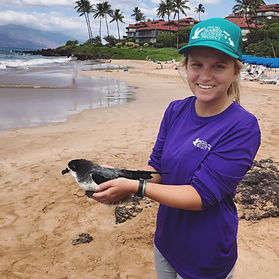
In my current role at the Maui Nui Seabird Recovery Project, I manage our data systems and assist with planning field operations. The Maui Nui Seabird Recovery Project's work is primarily focused on the long-term monitoring and conservation of Hawaiian seabirds and their nesting habitat. Additionally, in 2024, I completed my M.S. degree at Oregon State University, where I studied the foraging ecology and chick provisioning behavior of Marbled Murrelets across contrasting ocean conditions. I am still collaborating with researchers at Oregon State University on this work.

Katarzyna Wojczulanis-Jakubas
she/her
Professor
University of Gdańsk
Having a luxury of permanent position at uni I am the head of a great research group, where people work on their topic within the three lines of research: 1) seabirds response on the ongoing climate changes, 2) breeding ecology of seabirds (parental care, inter-individual communication, etc), 3) non-breeding ecology (wintering/migration).

Leilani Fowlke
she/her
PhD Student in Dr. Jones Evidence-based Restoration Lab
Northern Illinois University
I am a chick-rearing, restoration and translocation specialist with a focus on procellariiformes . From 2016-2022 I worked with Pacific Rim Conservation as their Animal Care Coordinator and a co-lead in rearing and releasing the translocated Black-footed Albatross, Bonin Petrel, Hawaiian Petrel, Tristram's Storm-petrel and Newell's Shearwater chicks. I am now conducting my PhD in Dr. Holly Jones Evidence-based Restoration Lab to document the reproductive life-history of the Phoenix Petrel and Polynesian Storm-petrel followed by a trial in-situ translocation for both species and a comparative analysis of reproductive life-history characteristics between procellariiform species.

Juliana Saviolli
she/her
Founder & Coordinator, AvesAmar | Veterinarian, Seabird Conservationist & Science Communicato
AvesAmar
I am a Brazilian veterinarian and seabird conservationist, and founder and coordinator of AvesAmar. My work focuses on seabird research, long-term monitoring, conservation, and wildlife health. I have led the development and implementation of monitoring programs along the coast of São Paulo and in port areas. Currently, I coordinate field activities for biological sampling to assess the health of tern populations breeding in São Paulo. Through AvesAmar, I also work with environmental education and science communication, using social media to share research and conservation knowledge and connect science with the public.

Aurore Ponchon
she/her
Researcher
Institut Méditerranéen de Biodiversité & d'Ecologie Marine & Continentale (IMBE-IRD)
I am a spatial and behavioural ecologist. I examine how seabird movements are influenced by individual, social and environmental factors and how they in turn affect individual breeding success, survival and population dynamics. To do so, I use miniaturized tracking devices coupled with statisical models as well as theoretical models.

Debs Allbrook
she/her
PhD candidate
University of Exeter
I currently research Black-legged kittiwakes nesting on an oil and gas rig in the Irish Sea, using remote trail cameras and GPS tags. Many platforms such as this one are subject to decommissioning in the next couple of years, and this study colony gives us a rare opportunity to find out the importance of these sites for kittiwakes with a view to understanding the impact of their removal, and how the birds fit into the wider metapopulation. My fieldwork involves stints offshore via helicopter. I am also a trainee ringer, and the Assistant Newsletter Editor for The Seabird Group.

Edin Whitehead
she/her
Research Assistant & Project Coordinator
University of Auckland, Northern New Zealand Seabird Trust
I undertake research on climate resilience and adaptation in petrels and shearwaters, looking at ecophysioloigcal and behavioural metrics and how they relate to environmental change. I coordinate research, conservation, and advocacy projects for the Northern New Zealand Seabird Trust. During the summer field season I work on contracts on offshore islands or at-sea, depending on what gets funded in any given year!

Cerren Richards
she/her
Research Specialist & PhD Candidate
Firelight Group, Memorial University of Newfoundland
My research interests focus on seabird ecology from local to global scales. I couple fieldwork, timeseries, and modern statistical tools to understand how seabirds respond to anthropogenic and natural drivers. My ultimate goal is to create sustainable conservation solutions. For my PhD, I work in partnership with Inuit community members and government bodies to co-produce knowledge about the seabird species and populations with the greatest limitations to environmental change in Canada. For ten years, I have also been actively communicating seabird science. I leverage diverse outreach tools to engage local to international audiences, foster inclusivity, and inspire communities.

Sydney M. Collins
she/her
Reseacher and Outdoor Educator
Toronto and Region Conservation Authority
I spend my days researching seabirds and teaching about birds and conservation as an outdoor educator! Through my academic research, I study consistency of behaviour across spatial and temporal scales and its applicability to conservation, specifically focusing on measures of animal personality and consistency of space use. My research is investigating whether Leach's Storm-Petrels (Hydrobates leucorhous) that exhibit consistent behaviour also experience consistent exposure to risks. I love using remote monitoring techniques (like PIT/RFID systems, GPS and GLS tags) to investigate consistency of behaviour and to answer questions about the life history of cryptic seabirds.

Johanna Bosch
she/her
Wildlife Habitat Biologist
Wildlife Research Division of Environment and Climate Change Canada
I currently work as a Wildlife Habitat Biologist (MSc.) with the Wildlife Research Division of Environment Canada, based out of Newfoundland and Labrador, where my days are spent working hands-on with Atlantic puffins, gulls, and Leach's storm petrels. Whether it's tagging birds for capture-mark-recapture studies or diving deep into developing new data analysis tools for seabird researchers, I bring a mix of seabird handling and coding skills to the table. From integrated population modeling for species like the Leach�s storm petrel to analyzing sediment cores that reveal past seabird colony dynamics, I�m passionate about combining ecological research with innovative methods to help preserve these remarkable species and their habitats.

Taylor Brown
she/her
PhD Candidate
Trent University
I study the behavioural responses of fledgling Atlantic Puffins and Leach's Storm-petrels to artificial light at night (ALAN) in the context of annual mass strandings of these two species in Newfoundland, Canada. Most of my work is experimental and conservation-based, with a focus on investigating phototaxis (both positive and negative) in response to light of various spectra and intensities and in different behavioural contexts. My hope is that the results of my research can inform coastal development policy and practice to reduce the effects of artificial light on seabirds.
bottom of page