top of page

WOMEN IN SEABIRD SCIENCE


Emilie Knighton
they/them
MSc Student
Acadia University
I work with colonial Red-breasted Mergansers to understand whether host Red-breasted Mergansers respond to conspecific brood parasitism by discriminating against parasitic eggs and how conspecific brood parasitism affects incubation behaviour. Using albumen to identify parasitic eggs and data loggers to track incubation activity, I investigated host behaviour in colonial Red-breasted Mergansers (Mergus serrator) at Kouchibouguac National Park, NB.

Anna Vallery
she/her
Biological Science Technician (Avian Biologist)
US Fish and Wildlife Service
I manage the banding permit and associated data for the USFWS Pacific Remote Islands and Monuments as well as work on a number of projects related to the research and conservation of the bird species that rely on these islands, most of which are seabirds. I also manage a project that is developing a machine-learning tool to speed up monitoring efforts that use drones and other imagery to count colonial waterbirds.

Katrina (Trina) Siddiqi-Davies
she/her
PostDoctoral Researcher
University of Oxford
Katrina Siddiqi-Davies is a postdoctoral researcher within the Oxford Biology Department, specializing in the captivating domain of movement behaviour and ecology, particularly focusing on a procellariform seabird, the Manx shearwater. She is responsible for leading fieldwork across multiple shearwater colonies to track shearwaters at all life stages and better understand their spatial distribution. Hopefully this will also help inform policy makers and offshore wind farm developers within the Celtic and Irish Sea. She is also interested in scientist and artistic collaborations/alternative ways to communicate ideas and writes poetry surrounding wildlife. She is also the Social Media Manager for the Seabird Group.
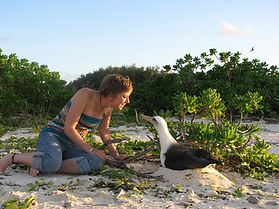
Sarah Gutowsky
she/her
Quantitative Seabird Biologist
Environment and Climate Change Canada
Sarah is the national coordinator of seabird monitoring and assessment in Canada. Her role is to assist in developing consistent and efficient monitoring strategies for Canada's seabirds that allow for effective assessments of population size and trends.

Tammy Russell
she/her
PhD Candidate
Scripps Institution of Oceanography
I research the at-sea distribution of seabirds, specifically how seabirds use ocean habitats, including protected regions, and how their distribution, abundance, and communities are changing with climate change. I also run the Penguano Project, a collaborative program that investigates the ingestion and food web pathways of plastic pollution in Antarctic penguins.

Elizabeth Bell
she/her
Ecologist
Wildlife Management International Ltd.
Long-term research programmes on New Zealand seabirds monitoring population trends, breeding success, survival and recruitment at colonies through the intensive monitoring of study burrows and night capture of seabirds on the surface. Banding all adults and surviving chicks handled during the work, and undertaking a range of tracking studies to understand foraging and migration patterns at sea as well as determine at-sea risks including climate change, fishing and pollution events.

Danni Thompson
she/her
PhD Student
University of Aberdeen
I first fell in love with seabirds whilst working on a remote Scottish island surrounded by internationally important colonies. Since then, I've worked in seabird monitoring, training citizen scientists to survey seabirds at sea, and assessing the impacts of offshore industries on seabird populations. My current research is looking at individual foraging behaviour specialisation in Falkland Island shags, using a mixture of biologging, stable isotope analysis and dietary metabarcoding.

Emily Burt
she/her
PhD Student
McGill University
I started working with seabirds for my Honours thesis in 2021, studying the foraging and movement ecology of incubating red-breasted mergansers in New Brunswick using GPS-accelerometers. I quickly fell in love with seabirds and my study population, so I returned to study these same red-breasted mergansers for Master's in 2022, where I have since fast-tracked to become a PhD student. For my PhD, I am investigating the ecological, social, and evolutionary factors that promote conspecific brood parasitism in both hosts and parasites using molecular methods (microsatellite genotyping) and behavioural observations using camera traps at the nest.

Annie Schmidt
she/her
Conservation scientist/Antarctica Program Director
Point Blue Conservation Science
In my current role, I manage a long-term research initiative focused on understanding Adélie penguin population dynamics in the Ross Sea. This comprehensive study involves monitoring penguin populations, tracking their feeding habits, and analyzing the ecological dynamics within their habitat. Our aim is to gain insights into the factors affecting these penguins' survival and breeding, as well as their interaction with the broader marine ecosystem. This project not only contributes to the scientific community's understanding of Antarctic wildlife but also informs conservation strategies to ensure the sustainability of these vital species and their environment.

Annette Fayet
she/her
Researcher
Norwegian Institute for Nature Research (NINA)
My research focuses on seabird spatial ecology, on topics dealing with behavioural ecology, life-history and population dynamics. I address a range of questions from understanding the drivers of migration and the consequences of migratory strategies on individual fitness and population dynamics, to investigating foraging niche differentiation in sympatric species, or the mechanisms of carry-over effects in migratory species. To address these questions, I use a combination of tracking loggers, video cameras, field experiments, and machine-learning analytical techniques. I work with mutliple seabird species across the North Atlantic, Indian and Pacific Oceans. At NINA, I co-lead SEAPOP fieldwork on the Røst archipelago (Northern Norway).

Eleanor Weideman
she/her
Coastal Seabird Project Manager
BirdLife South Africa
I am interested in the feeding and movement ecology of seabirds, and how this information can be used to inform conservation. My seabird work started on sub-Antarctic Marion Island, where I spent 13 months collecting baseline data on the feeding ecology and life histories of avian scavengers, as well as conducting long-term monitoring of ground-nesting albatrosses and petrels. Currently I am working on African Penguins, Cape Cormorants and Cape Gannets in South Africa. I use a suite of technologies such as animal-borne accelerometers, TDRs and cameras, as well as weighbridges to improve our understanding of the threats faced by these endangered species.

bottom of page